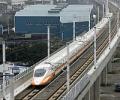
The government is likely to allow FDI in high speed trains and other projects.

There is a lot of optimism as regards the defence, railway and manufacturing sectors.
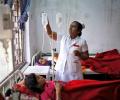
A dialysis machine contributes only 6 per cent to the overall cost.

The cost of the project will be Rs 21,738 crore, the sources said.

Finance Minister Nirmala Sitharaman on Tuesday said monetisation of Central Public Sector Enterprises (CPSE) assets is based on the principle of value creation for the government and investors and would bring about a paradigm shift in infrastructure augmentation and maintenance. Chairing the National Workshop with the states/UTs on Asset Monetisation organised by Niti Aayog, the minister sought the collaboration of states for the holistic development of infrastructure. She said India can become a $5 trillion economy, while striking the right balance between fiscal imperatives and socio-economic welfare, through active collaboration between the public and private sector.

The venture, they said, would focus on technology and media opportunities in emerging markets. Industry sources said the focus would be on digital media, with India being the big driver.

India will need an annual investment of Rs 15 trillion in infrastructure over the next five years, says Chandrajit Banerjee, DG, CII.

To generate ample private sector interest, there is a need to introduce market-linked tariff rates.
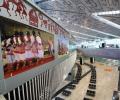
A ministry spokesperson said he wasn't aware of the development.

The government had last week decided to set up the 51 airports to enhance air connectivity to small cities in Andhra Pradesh, Jharkhand, Bihar, Punjab, Uttar Pradesh, Assam, Arunachal Pradesh, Madhya Pradesh, Rajasthan and Maharashtra.

Move is aimed at bringing private operators to run airports.

Realty players want single window clearance for all affordable projects, reports Karan Choudhury.

The Monsoon Session of the Lok Sabha was adjourned sine die on Friday after 19 sittings that saw the passage of 14 legislation while Rajya Sabha came to an end after passing nine bills.

Modi government must fix policy paralysis.
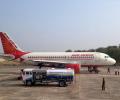
"The strategic divestment transaction of Air India successfully concluded today with transfer of 100 per cent shares of Air India to M/s Talace Pvt Ltd along with management control," DIPAM secretary Tuhin Kanta Pandey said in a tweet. A new board, led by the strategic partner, takes charge of Air India, he added.

By January-February, it's expected to have at least 100 million doses for the Indian government, reports Sohini Das.
In 2013, the government awarded less than 1,500 km of road projects under the EPC mode after it found no takers for PPP projects.

Santosh Kamath, partner (infrastructure and government services), KPMG in India, expects an extension of a tax holiday for the sector.
.jpg)
Many of the PPPs have not evinced interest, Prabhu said.
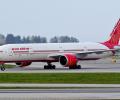
They say better late than never. For the Tatas, the original owners of Air India, bringing back the airline to its fold is worth the wait even if the attempt to privatise the bleeding national carrier by successive governments has taken over two decades. While many airlines have come and gone from the Indian skies since the time when the first move was made to privatise Air India to date, the salt-to-software conglomerate has never let the love affair with aviation, more so with Air India that its former chairman Jehangir Ratanji Dadabhoy Tata (JRD) had, to go off the radar. It is said that Tata group executives used to complain in private that JRD -- the pioneer of the Indian aviation industry -- spent more time worrying about Air India than the Tata group when he was heading both the entities.

We need to make better efforts to align job training with the skills the market demands of its workers, especially as advancing technology changes the types of jobs available in our economy: Alexander Acosta.
 © 2026 Rediff.com - Advertise with us - Disclaimer - Privacy Policy - Sitemap - Feedback - About us - Terms of use - Grievances